Who Gets to Live by the Sea
Continuing on from Part 1 …
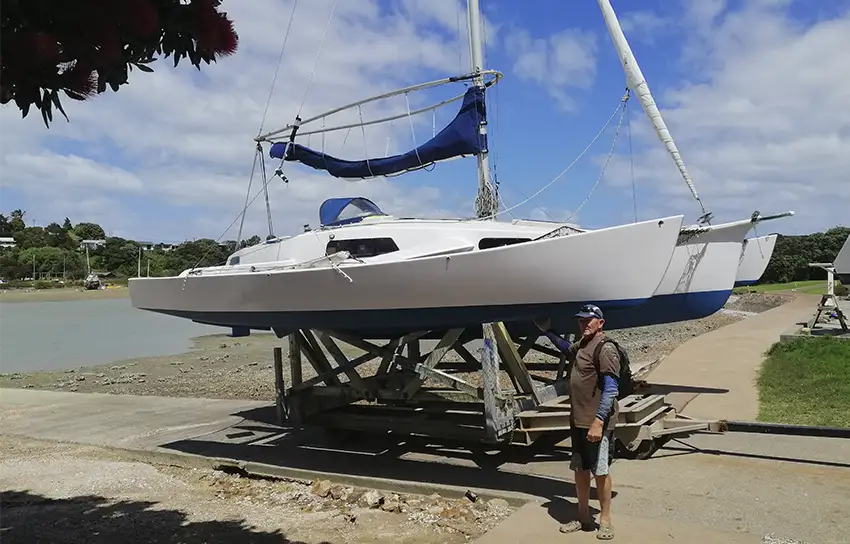
I bought trimaran Jiwa in the year 2000. Apart from the odd bit of rot in the deck which has needed repair, there have been no problems over the 25 years I have sailed her around the north-east coast of the North Island. I have pulled her out of the water onto a hard stand every seven years for a decent refit. The first two times were at Little Shoal Bay near Auckland’s harbour bridge, where I met some interesting characters.
One was Andrew Fagan, a well-known Kiwi rock star of the 70s and lead singer of the Mockers, who recently performed at Coroglen Tavern. Andrew is also a remarkable solo sailor. He sailed his tiny 5.4 metre yacht Swirly World to Australia; to the Kermadec islands, 1000 kilometres north of NZ; to the Auckland Islands, around 350 kilometres south of Rakiura/Stewart Island; and more recently into the depths of the notoriously rough Southern Ocean where sadly he was forced to abandon Swirly World to the mercy of the sea due to gear failure, during an attempt to sail the smallest boat single-handed, non-stop around the world.
What strength of character and bravery it would take to embark on such adventures. I would highly recommend his Swirly World books for those of you who love tales of the ocean.
Another interesting chap was Bob who had Romani ancestry and dreamed of one day voyaging back to Europe to experience the wandering lifestyle of his ancestors.
I remember us sharing the rare view one day of a very large digger being driven across the Little Shoal Bay mudflats to help a 4-wheel-drive that had become stuck in mud. Unfortunately, the digger also got stuck and the driver’s efforts to try and dig his way out only served to make it sink deeper into the unforgiving mud. The driver was a member of the local yacht club which could not afford to replace the $300,000 machine which they had hired. Bob and I could do nothing but stand on the shore as the tide came in and watch as the bright yellow digger was slowly submerged until at high tide, all you could see was the bucket sticking out above the green water. Part of me had to stifle a smile at the ridiculous humour of the situation. Fortunately, after many a legal argument, the club’s insurance company agreed to cover the loss. Unfortunately, a few years later, citing environmental concerns, local councils closed down several haul-out facilities in Auckland Harbour which catered for us less wealthy boat owners, including the one at Little Shoal Bay which had served as a boat maintenance facility for 80 years.
The slip at Putiki Bay on Waiheke Island escaped the closures and still caters for low budget boats like Jiwa. I have just returned from there after carrying out her latest seven-yearly refit. What an interesting bay. It is very tidal and is home to a wide variety of vessels – multi-hulls like Klis II which sit on dry mudflats during low tides, houseboats with onboard gardens and others which are less cared for – abandoned hulls slowly rotting into the mangroves. All kinds of craft housing all kinds of people. There are people living on boats in many of the bays on Waiheke’s southern coast. I think that council seems to turn a blind eye to some of the domicile regulations, given the shortage of affordable accommodation for the less well-off, and the ridiculously high average house price of $3.62 million, a figure brought about by the high demand for luxury homes on coastal property near our biggest city, spurred along by the absence of a wealth and capital gains tax. The rich get richer while the locals can’t afford to live there. Such is the way of the world at present.
Let’s hope we find a more equitable way to share resources without a violent backlash as has happened in centuries gone by. The three weeks I spent there were made more enjoyable by these boat-dwelling residents, some of whom suffered from substance abuse and other related issues, but who would always offer me help if they saw I needed it.
I wasn’t keen on saying thank you to one alcohol-dependent helper by giving him a 6-pack of beer, so after borrowing his sander for a few days when mine died, I offered him a bag of organic vegetables I had picked from my sister Sally’s garden. He looked at them and said with a cheeky smile on his face, “I don’t eat vegetables, but I drink Speight’s cider.” What can you do? Suffice it to say he didn’t eat vegetarian that night. There were others whose morning tea was usually brown and fizzy and one or two that shared a morning P pipe.
It was the first time in 25 years I had sailed Jiwa back into Putiki Bay where I first met her. Bernard, her designer, and Wayne who built her came aboard and we shared stories of boat design, boat building and of course, of some of my multiple adventures aboard Jiwa. After three weeks of scraping, sanding, fibre-glassing and painting by my sister Sally and her husband Alan (both of whom went beyond the call of duty), and me, Jiwa was ready to go back in the water. The slip master Pete, who has volunteered his services to Waiheke Boat Club for 20 years, expertly manoeuvred Jiwa down the ramp with his tractor, a tricky and somewhat stressful operation for all, and all he asked for was a box of Heineken.
The next morning, taking advantage of a 20-knot tail wind, accompanied by my lovely partner, crew and chef Sumi, we sailed out of Putiki Bay and headed for Port Jackson where we hunkered down for a sleepless night in 35 knots of wind sweeping down off Mount Moehau. The next morning gifted us glassy calm seas. We motored through Colville Channel and were surrounded by diving gannets and a few common dolphins. Gradually, more and more dolphins arrived and played on our bow wave. They were all quite small and some were accompanied by even smaller young ones that jumped playfully out of the ocean right beside us. Alan and I had been met by dolphins on the way up to Waiheke, so Jiwa was twice blessed to also have their company on the return journey. I like to think it had something to do with their liking the meaning of her name, Jiwa – soul, spirit, vital force. Safe sailing to all of you who answer the call of the ocean.
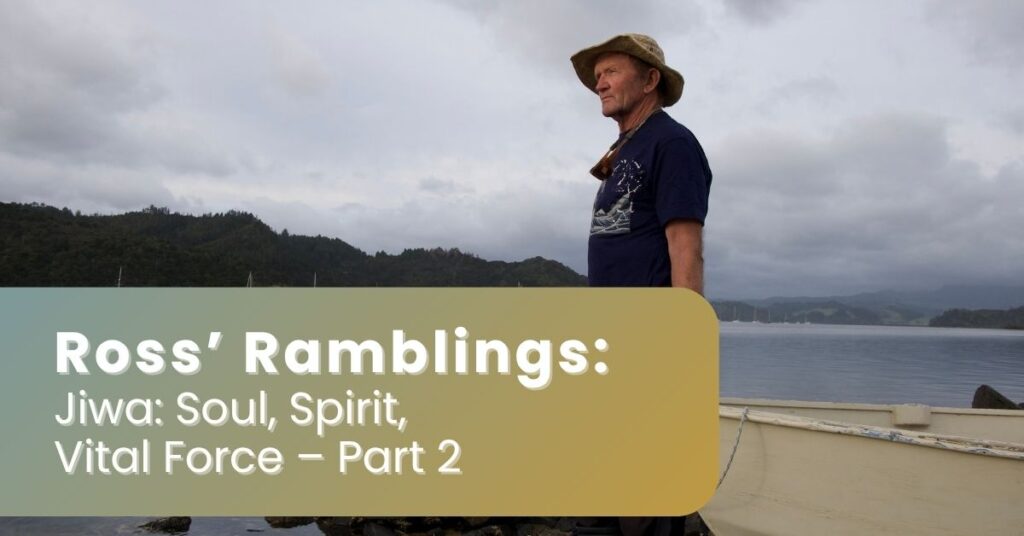
Words by Ross Liggins
Coromind: Coromandel’s Collaborative Magazine

Help us take Coromind Magazine to new heights by becoming a member. Click here
Change the Weather for Your Business: Advertise with Us.
Advertise your business in the whole Hauraki Coromandel in the coolest Coromandel Art Magazine, from Waihi Beach/Paeroa /Thames up to the Great Barrier Island.
Advertise Smarter, Not Harder: Get in Touch