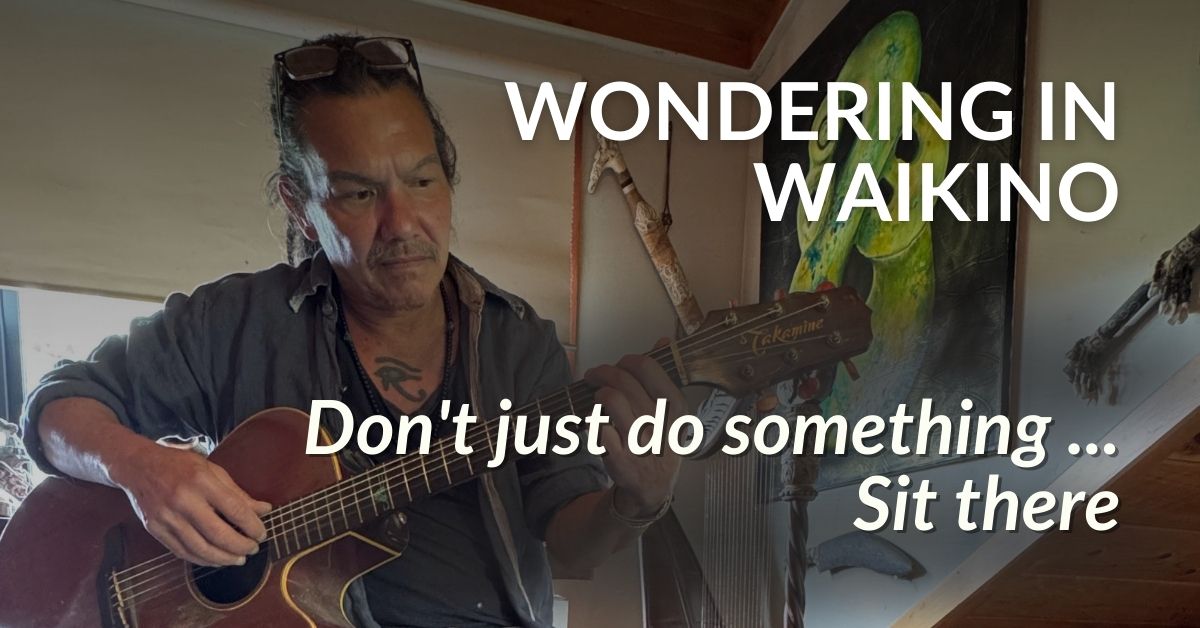
Most of us would be familiar with the sayings, ‘Don’t just sit there, do something!’, or ‘Idle hands are the Devil’s workshop’, a slightly more sinister version. Both imply that inaction usually results in loss or lack of reward. Nothing ventured, nothing gained. Or ‘Build it, and they will come’? They both suggest we get up out of our seats and be productive with our time rather than sit still. Even the sports brand Nike’s slogan is – Just Do It. This seems to be excellent advice for most life situations, as inaction is often not the foremost companion of success. However, there is always more than one way to perceive a situation or circumstance. Let’s delve, then.
Inaction may also represent a different scenario, suggesting contemplation and perhaps caution. In 1704, the English poet Alexander Pope targeted the literary critics of his day with an essay on criticism, and he finished up with the phrase, ‘Fools rush in where angels fear to tread.’ Subsequently, many others in literature and song have echoed this phrase, such as Thomas Hardy, James Joyce, EM Forster, and Frank Sinatra.
I suppose the phrase ‘Learn to be still’ follows in parallel. Precipitous, hasty decisions or actions tend to favour mistakes and misfortune. But perhaps there is a middle path, one that encourages thinking, planning, structuring, coordinating and dreaming but without a computer, phone, book or even a pen or pencil. An approach that allows us to ‘feel’ the situation before ‘doing’ it. That takes a certain stillness.
In this state, we may appear to be idle; our eyes may even be closed, yet we are not asleep, inactive or lazy. We are in fact meditating, contemplating, inventing, creating, theorising and imagining. We surrender to the stillness and alignment to lead the way. We may measure thrice and cut once. But there comes a time when we must draw the line and commit to physical action. When do we decide what move to make, which person to call, which initiative to follow or how much time and money to invest? Ideas are free, and they are like noses. Everyone has one. But ideas never materialise on their own; they must be executed, experimented with and materialised. So, what transforms an idea into a reality? The line is blurred, making it all one big, fantastic adventure.
One suggestion is known as Ockham’s Razor and credited to William of Ockham, an academic philosopher and theologian. He stated that, “Among competing hypotheses that predict equally well, the one with the fewest assumptions should be selected”. Deepak Chopra’s fourth spiritual law of success similarly echoes the principle of “Do less, and accomplish more.”
It is based on the idea that nature’s intelligence functions with effortless ease, with carefreeness, harmony and love. Even Lao Tzu, Chinese philosopher, and author of the Tao Te Ching, said “An integral being knows without going, sees without looking, and accomplishes without doing.”
So we could run around constantly busy, multi-tasking and conjuring to arrive at the finish line, or we could sit around meditating and dreaming for days, hoping it will manifest on its own. Do we work hard or smart, or is it a combination? As much as we may believe in spontaneity, organising rather than agonising, seems to be a very valid approach. Or do we add madness to method versus adding method to madness? It reminds me of a phrase most commonly associated with Sylvia Boorstein. She captures the essence of it all quite well, and although it sounds simple, it isn’t as easy to do as it seems. Is it the ‘unbearable lightness of being’? Or simply, as she stated: Don’t just do something … sit there!
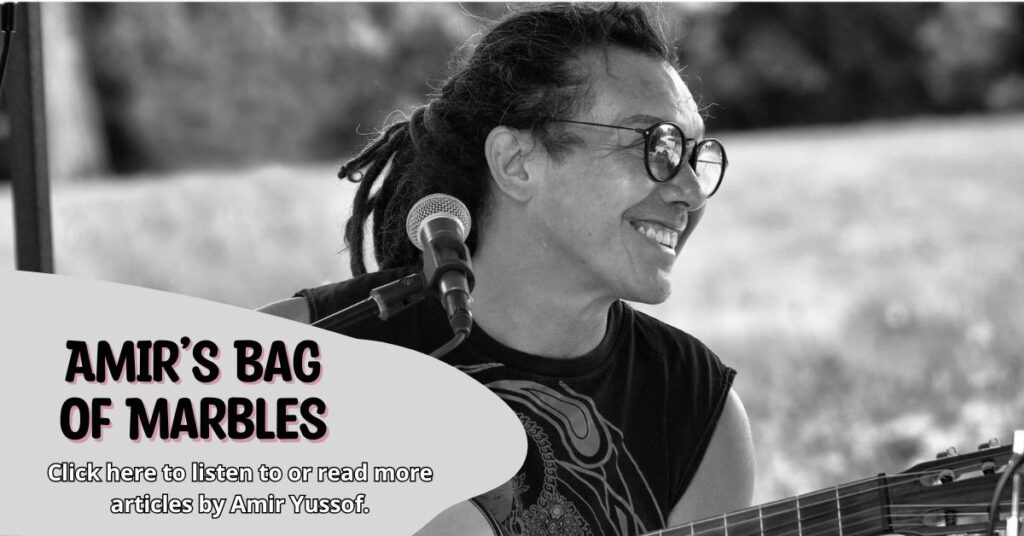
Words by Amir Yussof
Find out more about Amir here.
Coromind: Coromandel’s Collaborative Magazine

Help us take Coromind Magazine to new heights by becoming a member. Click here
Change the Weather for Your Business: Advertise with Us.
Advertise your business in the whole Hauraki Coromandel in the coolest Coromandel Art Magazine, from Waihi Beach/Paeroa /Thames up to the Great Barrier Island.
Advertise Smarter, Not Harder: Get in Touch