
Rhona Haszard: A Bright Star that Burned Too Soon
“Every child is an artist. The problem is how to remain an artist once he grows up.” Pablo Picasso
A child of Thames, Alice Gwendoline Haszard, known as Rhona, remained an artist throughout her childhood and into adulthood – a short life however, that ended tragically at the age of 30 years. Rhona was born at Pārāwai, Thames on 21 January 1901, the daughter of Alice Elizabeth Vaughan Haszard, née Wily, and Henry Douglas Morpeth Haszard. (1) Henry had a long and distinguished career in the Department of Lands and Survey, until his retirement in March 1921.
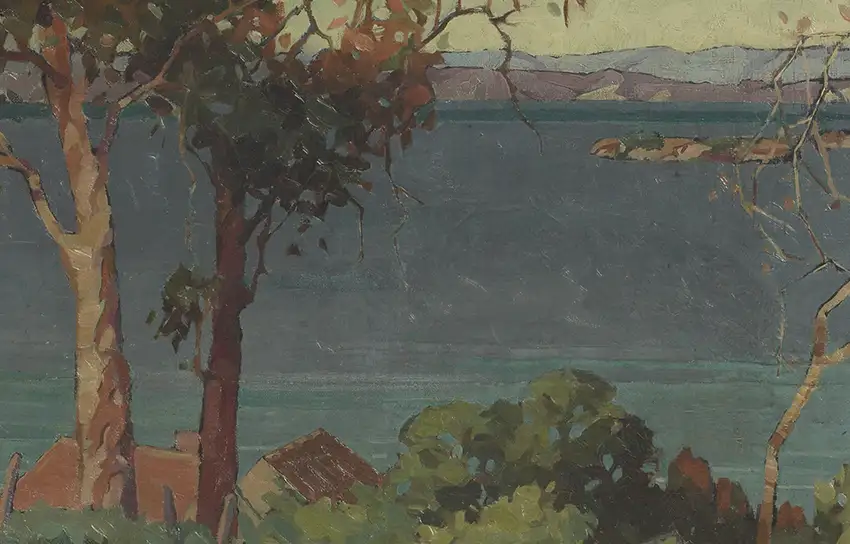
Rhona showed artistic talent from a young age. As a result of her father’s job, the family moved often, and during their time in Hokitika, Rhona was a pupil of artist Hugh Scott. The family then moved to Invercargill, where Rhona attended Southland Girls’ High School. Her mother died in November 1918, at the age of 53 years.

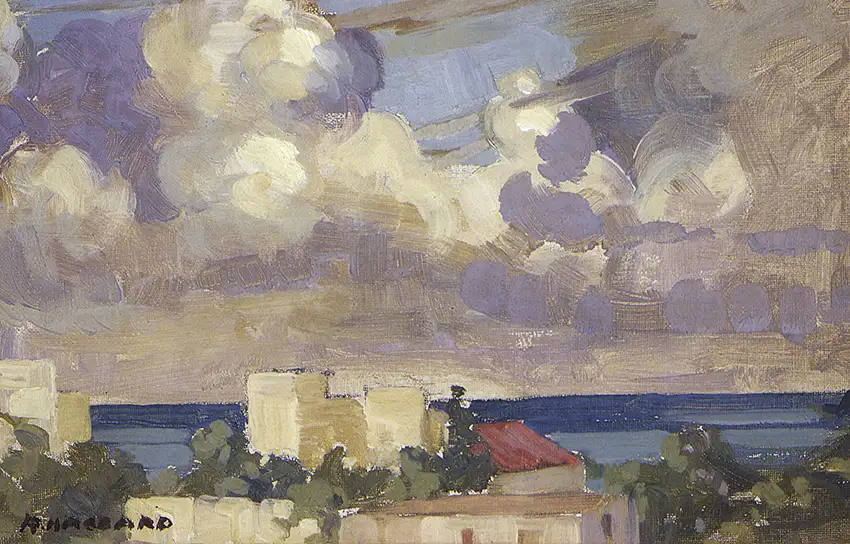
The following year the family moved to Christchurch, and from mid-1919 Rhona studied at Canterbury College School of Art, now Ilam School of Fine Arts, where she joined an illustrious group of women artists. In 1921 at the age of 20 she became a member of the New Zealand Academy of Fine Arts, and the following year exhibited with the Canterbury and Auckland art societies. Rhona was considered “one of the most spirited and promising of the Canterbury students.” (2)
In late December 1922, Rhona married Ronald James McKenzie, a fellow student and part-time tutor. (3) They divorced three years later in 1925. Rhona became romantically involved with an ex-army officer, Leslie Greener, and they married in Waihi, on 21 December 1925. (4) In 1926 they travelled to the Channel Islands, where Leslie’s parents lived, and then to France, where Rhona studied for a time at the Academie Julian in Paris.
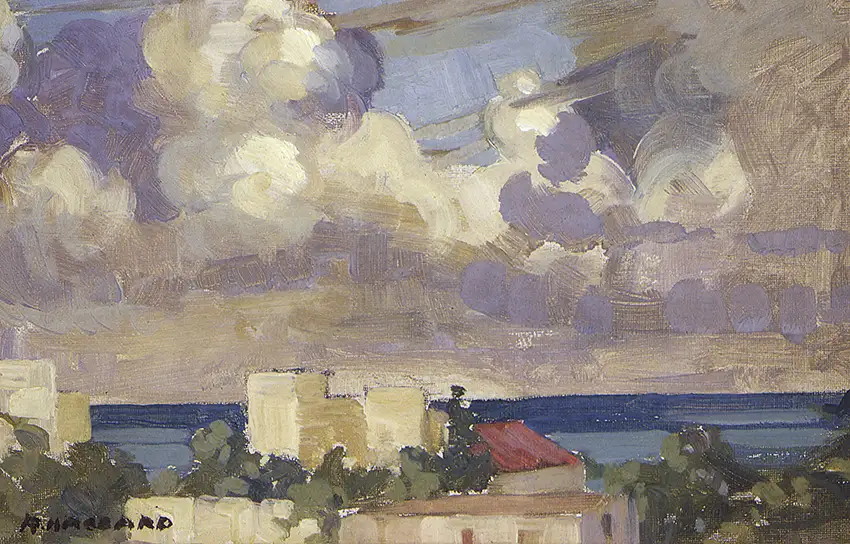
It was during this period that her work developed maturity, and a Post-Impressionist style. This style of painting developed from a predominantly French art movement that encouraged vivid colour to enhance emotional impact, distinctive brush strokes, geometric forms, and a move away from strict realism. Vincent van Gogh, Georges Seurat, and Pablo Picasso were famous post-impressionists.
In 1927 Rhona and Leslie moved to Egypt, where he had accepted a job at Victoria College, Alexandria, tutoring in art and French. (5)
On 16 February 1929, an article in the Hokitika Guardian noted that Miss Rhona Haszard (Mrs Leslie Greener) had held an exhibition of her paintings in December 1928, at Claridge’s Hotel, Alexandria. (6) The article acknowledged her ‘artistic maturity’. Her paintings were landscapes depicting scenes from New Zealand, Brittany, Sark, France and Egypt.

Rhona also became adept at the new graphic process of linocut printing, and held a joint exhibition with Leslie at the Gallery Paul in Cairo, March 1930. Back in New Zealand, the Thames Star, 3 July 1930, noted that Mrs Greener had received an invitation on behalf of H.R.H. the Prince of Wales to contribute to an exhibition in aid of the British Legion, in the Grafton Gallery, London, 1 June 1931.
The letter stipulated that only prominent artists were to be invited to contribute, and that Rhona’s work would be representative of the best in modern art. (7)
At the age of 30 years, Rhona sadly fell to her death from the Victoria College Tower, where she and her husband lived. She had been sketching in the tower the night following the opening of her last exhibition. (8) Two years after Rhona’s death, an exhibition collated by her husband toured New Zealand galleries. The exhibition confirmed her place in the art history of New Zealand.
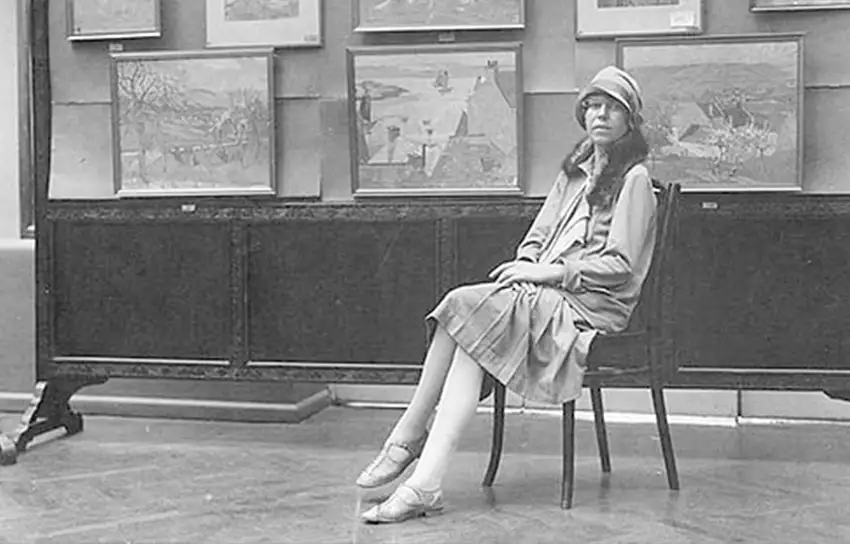
The Museum of New Zealand Te Papa Tongarewa classifies Rhona Haszard as one of a number of ex-patriot women artists whose work significantly influenced the visual arts in New Zealand in the first part of the twentieth century.(9)
A bright star in the world of art – another famous Thames woman, who went on to capture the hearts of many, and contribute to the enrichment of the human experience.
References: 1. BDMNZ, 1901/3144; 2. Te Ara, Dictionary of New Zealand Biography, teara.govt,nz; 3. BDMNZ, 1922/.48; 4. BDMNZ, 1925/59; 5. Biography of Rhona Haszard, collections.tepapa.govt.nz; 6. Papers Past, Hokitika Guardian, 16 February 1929, page 1; 7. Papers Past, Thames Star, 3 July 1930, page 5; 8. The New Zealand Herald, nzherald.co.nz, A Talent Taken Too Soon, by Graham Reid, 23 November, 2004; 9. Text originally published in Te Tai Awatea, Te Papa’s onfloor multimedia database, (2001); Image of Rhona Haszard with permission, Alexander Turnbull Library Te Puna Mātauranga o Aotearoa, (PA-Group-00079, photographed with artworks, late 1920s or very early 1930s.
Words by Robyn Pearce, volunteer, Thames Museum Te Whare Taonga o te Kauaeranga
Coromind: Coromandel’s Collaborative Magazine

Help us take Coromind Magazine to new heights by becoming a member. Click here
Change the Weather for Your Business: Advertise with Us.
Advertise your business in the whole Hauraki Coromandel in the coolest Coromandel Art Magazine, from Waihi Beach/Paeroa /Thames up to the Great Barrier Island.
Advertise Smarter, Not Harder: Get in Touch