The word photography comes from the Greek phōs meaning light, and graphé meaning drawing or writing. So, photography literally means drawing or writing with light.
During the goldrush era in Thames, visiting and local photographers captured images of the rapidly developing town and its inhabitants, and a number of photographic studios were established such as: Henry Albert Frith, 1869-1878; the Foy Brothers, 1872-1886; and William Henry Reed, 1872-1878.
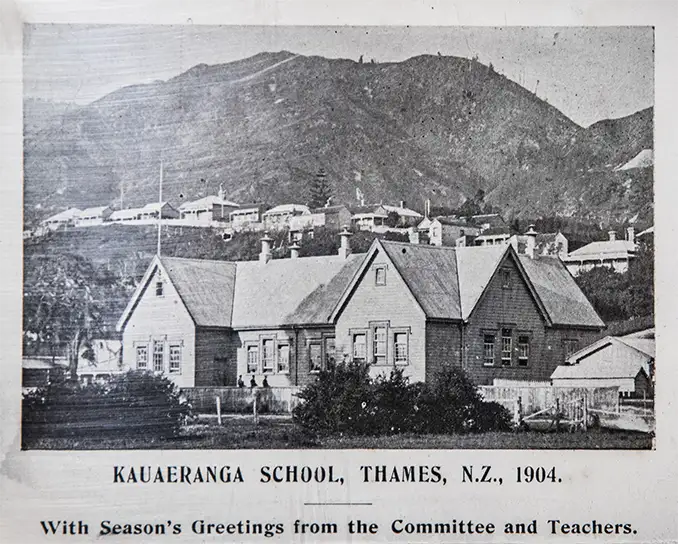
So, what prompted the desire to be photographed? Unlike painted portraits or pictures created in black and white silhouette form, photography was relatively cheap, took less time in comparison, and was available to a wider demographic. Photos were a way of preserving memories and everyday life, and a visual means of telling stories, preserving one’s identity and personality, and capturing moments in time. Photos were often sent to family and friends back home, providing a visual insight into the lives of those who had dared to travel to far-off lands in the hope of a better life. They also provided comfort and a sense of connection, as for most, it was unlikely they would meet up with distant families again.
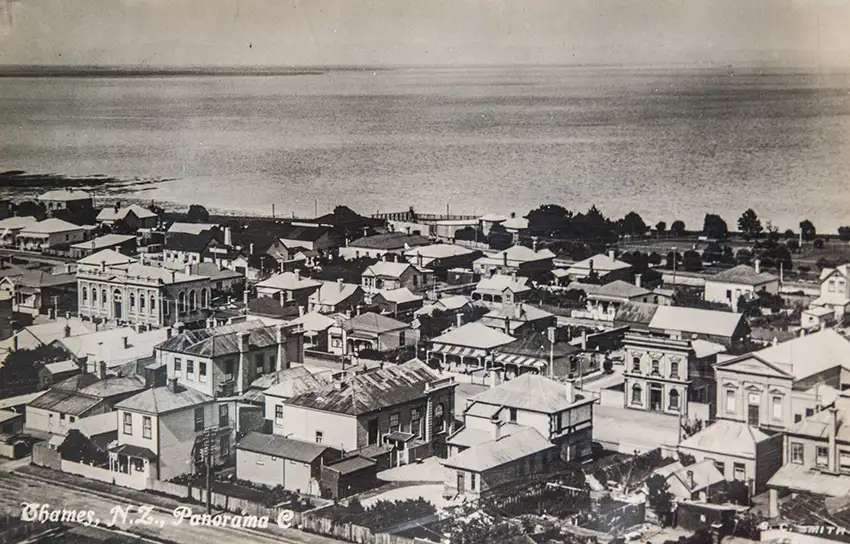
One of the most important characteristics of photography was its immediacy. The goldfields of Thames and the Coromandel Peninsula were rich in opportunities to capture everyday life through the camera lens, and record historical events as they happened – information that would be of great value to future archaeologists, and historians.
The first written account about light reflections and image, is credited to the Chinese philosopher, Mozi in approximately 400 BCE. Around 530 AD, Anthemius of Tralles was one of the first in recorded history to use a darkened chamber to explore optical phenomena, and in 1685 Johann Zahn invented the first portable camera. In 1727, the German professor of anatomy, Johann Schulze, proved the darkening of silver salts was caused by light not heat – thus providing, along with the concept of the camera obscura, the basic technology necessary for photography. The camera obscura meaning darkened chamber, a device where light passing through a small hole projects an inverted image onto a surface. However, little progress was made until Joseph Nicéphore Niépce took the first photo in 1814, thus both Zahn and Niépce sharing credit for the invention of the first working camera.
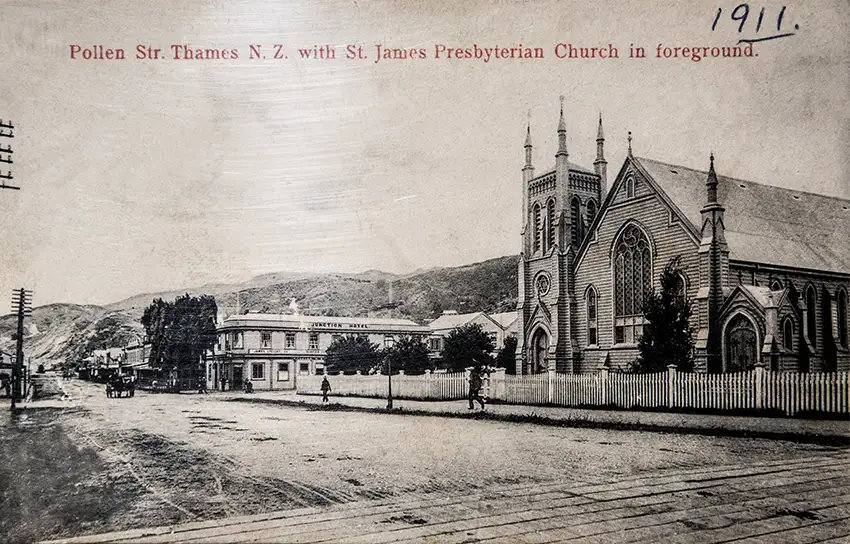
By 1839, Louis Daguerre was capturing permanent images on metal and paper. George Eastman made cameras simple and easy to use for the masses with the popular Kodak in 1888, which used spool-wound photographic film and had a press button mechanism. The movie camera became a reality in the mid-1890s, followed by the Brownie camera in 1900.
Then came 35mm film and colourisation, instant Polaroid cameras, and eventually digital cameras. A digital camera prototype was developed in 1975, with the first commercially available digital cameras appearing in the late 1980s and early 1990s.
The 1990s and beyond saw cameras becoming smaller, cheaper and faster, leading them to be a component of most smartphones. Software was also readily available to process, edit and enhance digital photos at home, on personal computers.
Whether you are an enthusiastic photographer, or a lover of artefacts in general, Thames Museum Te Whare Taonga o te Kauaeranga has an extensive collection of cameras through the decades, from the 1886 Lancaster Special Instantograph camera, to the Agfa Synchro box camera, Eastman Kodak Bull’s Eye, Kodak Instamatic 155X, Minolta Autopak-8 D6 movie camera and more.
In 2026, photography continues to be a means of documenting human experience, and capturing a visual history of people, places and events. The camera obscura was the beginning of the camera evolution. What is the future of photography in this rapidly changing technological world we live in, and will artificial Intelligence play a part?
References: Thames Museum collection archives; Britannica, britannica.com/technology/photography
Words by Robyn Pearce, Volunteer, Thames Museum Te Whare Taonga o te Kauaeranga