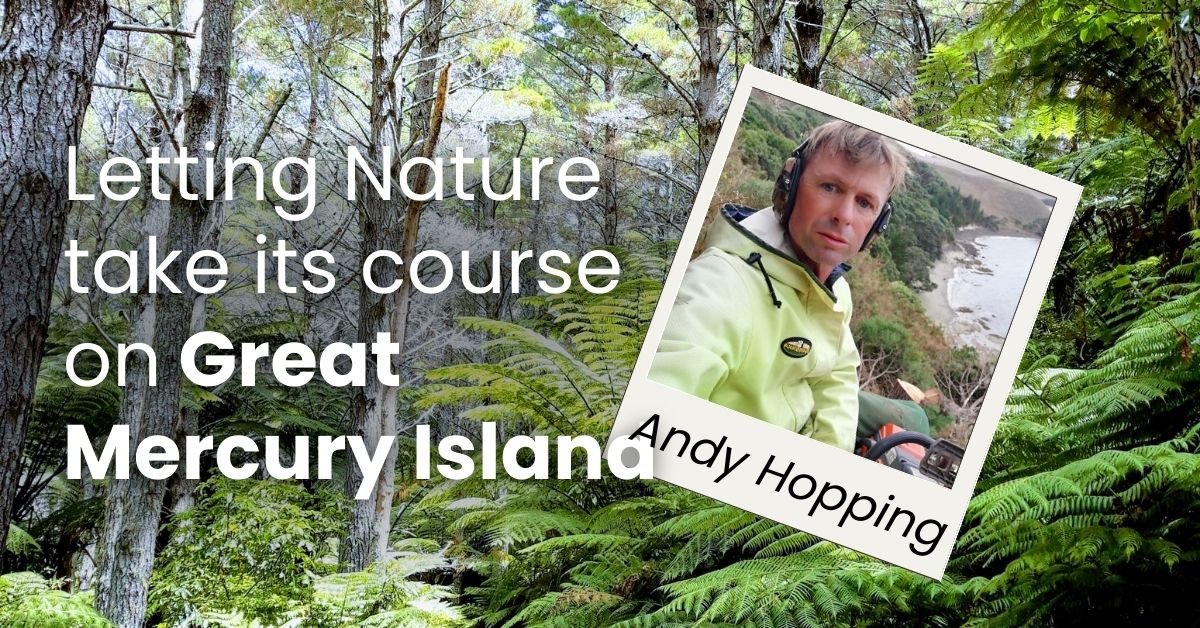
Ahuahu & Andy Series – Kākā, Pines, and the Slow Return of Native Forest
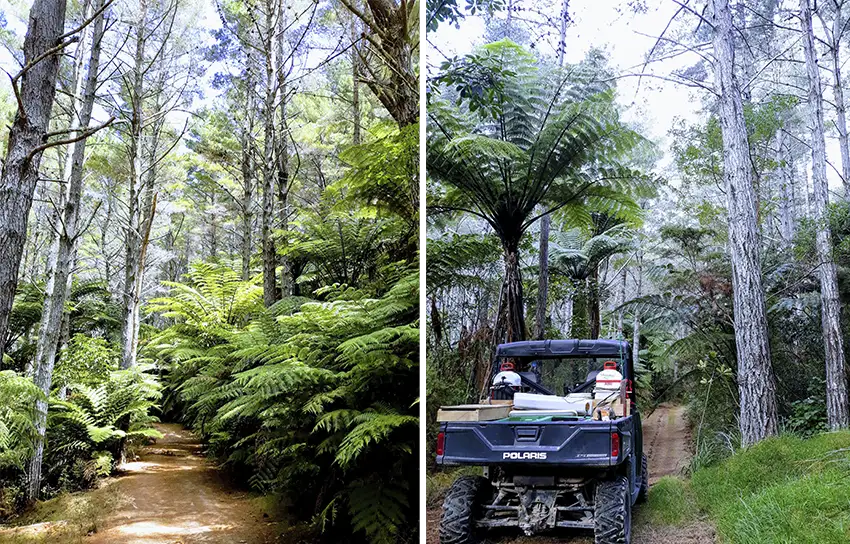
If you look out at Great Mercury Island from Black Jack Road, you can see the full length of the island from north to south. On the southern half, there is a big pine tree plantation which is now over 40 years old, planted during the Muldoon ‘Think Big’ era on land which is considered very poor farmland. The pine forest became economically and environmentally difficult to harvest.
Where erosion is a problem, invasive plants and vines follow; pampas, woolly nightshade (also known as tobacco weed), gorse (not so bad), and moth plant all love land with exposed earth.
If the pines were to be harvested, it would undoubtedly create a vast weed and erosion issue – good for goats, but that isn’t the goal.
Alternatively, as it stands now, the pine forest has accidentally become quite a unique native nursery.
The understorey in the pine forest is up to four metres tall, self-seeded by seed naturally present in the ground; it is a reverting native forest.
In another 40 years, the pines will die back and rot into carbon on the forest floor, leaving a beautiful diverse young native forest from seed that is naturally occurring on the island.
Being original island seed is a bonus. In a sense, it is another case study: mature pine plantations as nurseries. There is discussion about creating light wells in the pine forest which can also be viewed as a case study. In my opinion, I don’t see any need to accelerate light wells, as the forest is already experiencing natural light wells from storms. Small pockets of pine forest collapse due to storms or intense wind blowing up a gully, naturally exposing patches of native trees.
More interestingly to me, kākā (parrots) are really helping the forest break down. They strip bark off, looking for bugs and grubs, and in doing so are accelerating the demise of the pines simply by being kākā – ringbarking branches and treetops.
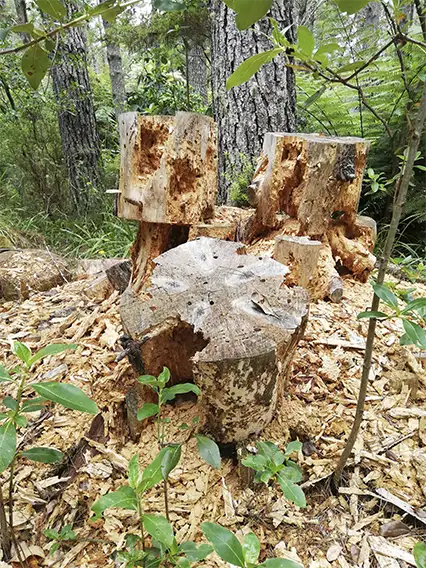
I prefer to watch rather than to mess around with different techniques artificially, unless the issue is used as a case study. Even so, I find the case study about kākā doing the work far more interesting than other techniques for killing the pines, such as drill and fill, clear felling or spraying treetops.
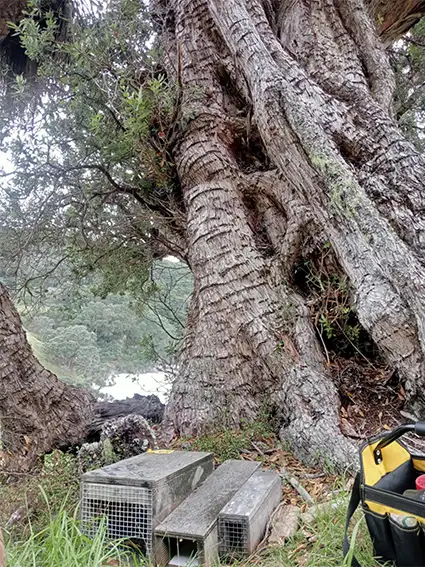
Native trees don’t have the same kind of bark that a lot of exotic trees have. The kākā love stripping off big sheets of bark from exotic trees to eat grubs, which ringbarks the branches, but native trees are quite immune to this behaviour. There was one trap station which for two years was completely buried by pōhutukawa bark and every time I visited the trap I had to dig it out.
I called that huge tree, which was clearly targeted by kākā, the ‘naked tree’. It had the tell-tale horizontal grooves in the trunk and branches that kākā make. I asked various people, ‘Why do kākā make them?’ about these grooves, which are common around the island – though in other cases not nearly as intensive as the ‘naked tree’. I didn’t get a clear answer.
One December, the big old grandad pōhutukawa blossomed like no other grandad pōhutukawa I have ever seen. It was striking; underneath, my traps were no longer covered in bark because there was none left to fall from the nude tree. I wondered if the kākā had farmed this tree intentionally or if there was a critter colony in the tree the kākā were feeding on. Had they intentionally made it bloom by stressing it to attract bugs or nectar? Either way, the tree became a standout and to this day it has scars from top to bottom.
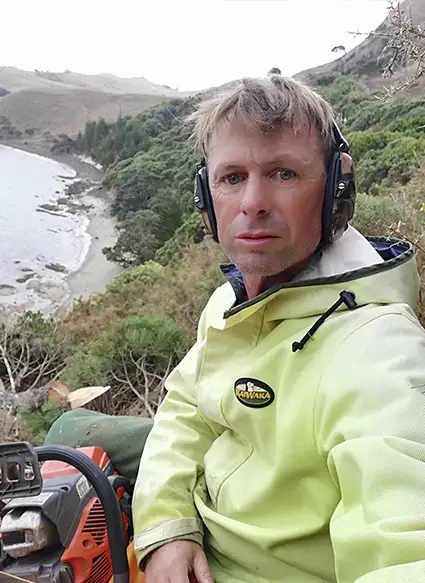
Words by Andy Hopping
You can read Andy’s full series on Ahuahu (Great Mercury Island) here.
Coromind: Coromandel’s Collaborative Magazine

Help us take Coromind Magazine to new heights by becoming a member. Click here
Change the Weather for Your Business: Advertise with Us.
Advertise your business in the whole Hauraki Coromandel in the coolest Coromandel Art Magazine, from Waihi Beach/Paeroa /Thames up to the Great Barrier Island.
Advertise Smarter, Not Harder: Get in Touch