
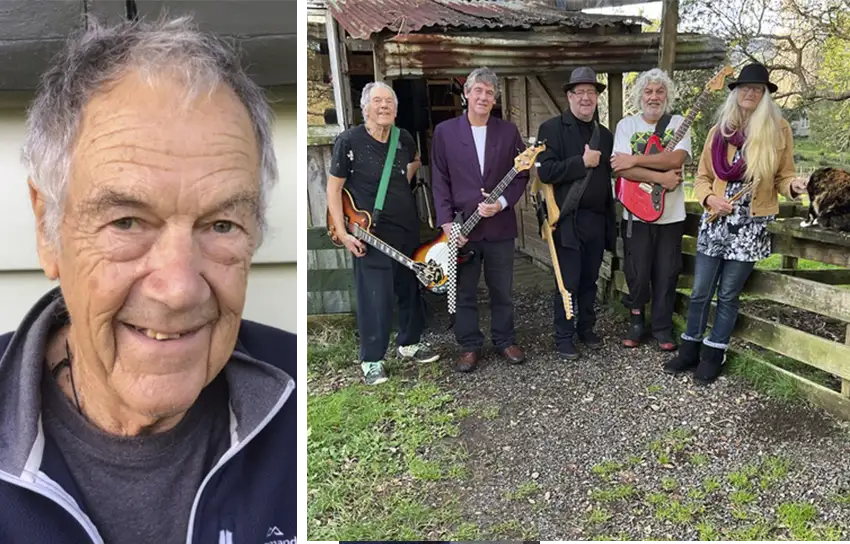
A longstanding stalwart of the Colville music scene, John Veysey’s musical talents have gone largely unnoticed.
Veysey is a prolific singer-songwriter whose penchant for toe-tapping country/blues tunes with catchy hooks and riffs have made him much-loved by those who know him.
John Veysey grew up in Bournville, UK in the 1950s. He reminisces fondly on the musical climate at the time.
“After the second world war, the country was getting back on its knees in time to experience the wave of American music, ‘black’ music, which swept Europe in the 1950s. Up until then Mario Lanza and George Formby had ruled the waves. Frank Sinatra ruled them on the other side of the Atlantic. I grew up on popular classical music: Beethoven’s and Schubert’s symphonies, Strauss waltzes and Chopin on the piano. The symphonies produced pictures in my mind and the riffs stuck in my head. By the time I reached secondary school I was already a musical snob.
When singing parts were offered in operettas by Gilbert and Sullivan I turned them down at age 12. Was I really so snooty or was I simply terrified of going in front of a crowd? Whatever the reason, I was a big disappointment to my music teacher when I refused to join his choir let alone play ‘Sweet Little Buttercup’ in his production of The Mikado.”
The explosion of rhythm and blues in the 1950s expanded Veysey’s tastes.
“We got pop charts littered with Elvis Presley, the Everly Brothers, Buddy Holly and others.
The Everly Brothers and Buddy Holly produced the first pop songs to really take my ear. Three chords and a strident beat, but also great harmonies. In those days everyone understood how to play rhythm and blues and country music so I could sit down with any strange musician and expect to jam together successfully around a simple repetitive structure.”
Veysey teamed up with a school friend to cover these popular songs.
“We learned Buddy Holly songs strumming on a couple of Spanish guitars. We took the pick-ups out of telephone hand-pieces and taped them to the top of the guitar soundboards with numerous electric strands sellotaped to an amp. In the school holidays we would turn up at a dance where a real band was playing and when they took a break, we’d get our guitars out and blast out a few songs with the band’s drummer and bass-player who we’d never met.”
After leaving school, Veysey did not pursue music for some time, opting to study Agriculture.
“I attended a middle-class privileged school, after which being a pop-singer was not considered a ‘proper’ career option. So followed 10 years of ‘doing the right thing’; studying, qualifying, entering a ‘good’ career, marriage, children … before I heard the call of popular music once again.”

Veysey moved to New Zealand in 1967, settling in Wellington, where he initially worked on farms, then in TV production. Moving to the Coromandel eventuated because of an unprecedented catastrophe.
“At the end of 1976, my home was flooded out in the Hutt Valley and I moved to Coromandel to stay with some friends who had moved there after giving up the same career a year before me.
I listened to the latest music and jammed a bit with whoever played an instrument. I felt a drive to do more. I had the time. I blamed being in such an out-of-the-way place for my lack of musical fulfilment, surely I would find the right musicians in the big city. So, in 1979 I moved back to Wellington. I pulled players together, hired practice rooms – cheap in condemned central-Wellington buildings due for demolition.”
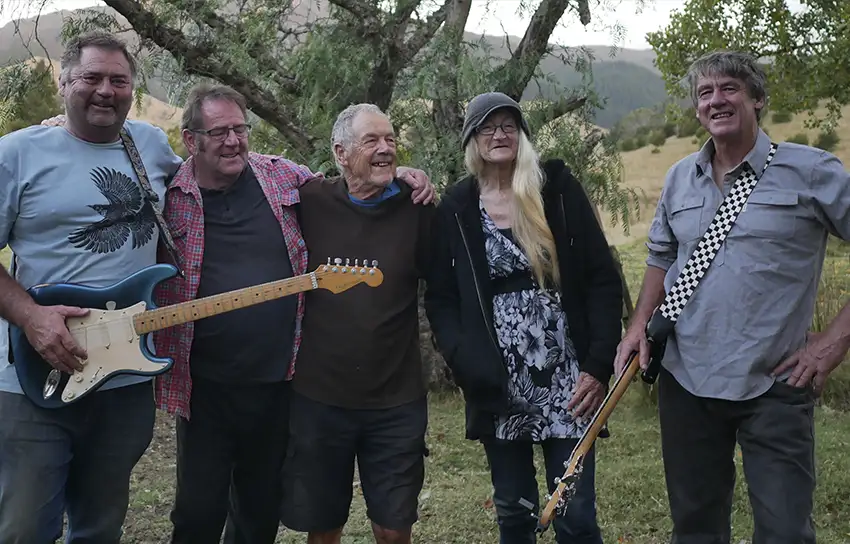
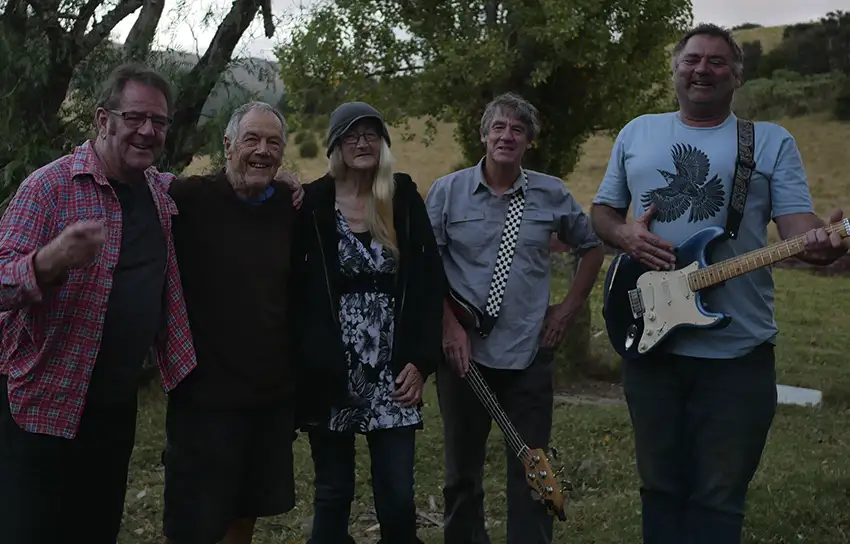
In 1986, Veysey moved back to the Coromandel. This time, he more easily found musicians to play with, forming the band JV and the Rockers. The band played local gigs and made recordings of Veysey’s original music.

“We became known as JV’s Rockers by Coromandel locals from our beginnings in 1987. Personnel changed and we have not changed the name. Just haven’t had a name other than JV’s. Any band which I lead is called JV’s.”
The Rockers have gone through a variety of different lineups over the years. Veysey has released two albums, You Can See a River (2013) and Kiwi on a Washing Line (2024).
He continues to write and record music. A third album is in the works.
“Each song begins with a strum of the guitar. Two chords back and forth in a certain rhythm. As I play it through, a string of words come along to enforce the rhythm so when the verbal line and chords are played together the song makes you tap your foot. I have a line to sing and a second line has to follow on and make sense. Only then do I find out what the song is about. The guitar riff is what the song is about and demands a solo. The fun for me is laying down a rhythm which makes the body swing, the foot tap. If that groove is laden with delicate or driving solos on any instrument and it’s still a groove, I’m in heaven. The rest is secondary.”
Words by Nur Peach
Coromind: Coromandel’s Collaborative Magazine

Help us take Coromind Magazine to new heights by becoming a member. Click here
Change the Weather for Your Business: Advertise with Us.
Advertise your business in the whole Hauraki Coromandel in the coolest Coromandel Art Magazine, from Waihi Beach/Paeroa /Thames up to the Great Barrier Island.
Advertise Smarter, Not Harder: Get in Touch