Teaching the Land to a Generation
The following is a glimpse into the life of William Lewis Townson – a man who was dedicated to his botanical work, and had an expert knowledge of the native birds of New Zealand. He was also interested in Māori customs, and was a collector of Māori artefacts. Because the North Island had been well examined, William’s search for rare and interesting native plants was mainly carried out in the South Island. Besides his botanical interests, William was a good chess player, holding the championship cup of the Thames Chess Club, was active in the church, took a great interest in good literature and gardening, and had a great love for music.
William Lewis Townson was born on 23 May 1855, to Benjamin Townson, a surgeon and physician of Liverpool, and Mary Ann Townson née Thorpe. Both William’s parents were devout Quakers. It is likely William’s love of the outdoors, and his interest in botany, was nurtured by his father. William’s brother Charley spent some time as a patient at the Seaforth Sanatorium, where he was being treated for tuberculosis. When William’s father visited the family in Seaforth, he would take his children on long hikes, roaming the fields of Litherland and the Crosby sandhills, explaining the interesting flora of the area to his children.
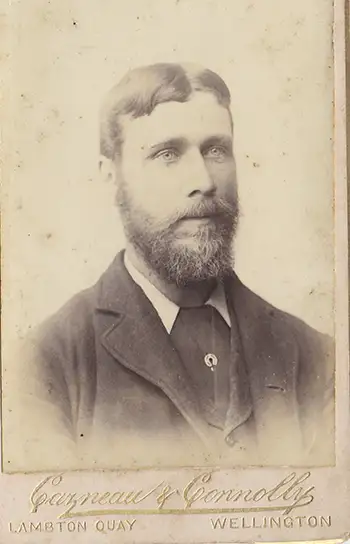
On 28 October 1878, William arrived in Port Chalmers, New Zealand aboard the ship Mataura. Originally training with a view to qualifying for medicine, Townson chose to become a pharmaceutical chemist, and was registered as a chemist and druggist on 6 July 1888. He was 33 years of age. He married Lucinda (Lucy) Dagg, 24 June 1889. Lucy was born in Masterton, and was one of ten children of Irish parents, Robert and Lucinda Dagg. William opened the Central Pharmacy and Dispensary in Palmerston Street, Westport, and in June 1890 their daughter Lucinda was born.
By July 1917, now aged 62, Townson was living in Thames, New Zealand, having taken over the pharmacy of the late John William Hall. Townson continued his search for interesting and rare species around Thames and the Coromandel.
He sent his good friend, Thomas Frederick Cheeseman, all his specimens to be carefully studied and identified, and talked with great enthusiasm about the kauri which he described as “the noblest of trees”.
William organised a Rambling Club for the students of Thames High School who, under his guidance, developed a keen interest in botany. For many years, on a weekly basis, the students followed him through the bush and over the hills, searching for rare and beautiful native specimens – Mr Townson informing the students of their botanical and English names, and describing them in great detail. During the Christmas school holidays, a competition for the best collection of flora was organised by the school. Mr William Hammond, a teacher at Thames Central school and a very keen botanist himself, judged the event. The winner was F.G. Short, whose display featured over 200 specimens, some rare and valuable, gathered from as far afield as Cape Colville and Mercury Bay.
William Townson died on 11 August 1926, aged 71 years. Amongst the beautiful floral offerings that covered his bier, none were more so than those gathered and arranged by the pupils of Thames High School, and members of the school Rambling Club. Their heartfelt floral contributions were a symbol of respect for their mentor, guide and friend Mr Townson, and a testimony to the man who taught them so much about the flora of New Zealand. William is buried in Shortland Cemetery. His wife, Lucinda, died on January 12 1944 and is buried in the same plot.
In conclusion, there is no doubt that William Lewis Townson contributed on a large scale to the knowledge of New Zealand botany. His beloved hills, mountains and forests were his source of joy.
Further reading: A Most Delightful Pursuit, William Lewis Townson, his life and works, compiled by Ian St George, istge@yahoo.co.nz, http://onadmiralroad.co.nz/. ISBN 979-0-473-67135-8, Reference: Seaforth Sanatorium – (Lancet, 21 April 1906, p. 1142: Northern Star and Farmers Chronicle, 23 Jan.1908, p.5;) Transactions and Proceedings of the Roya Society of NZ, 1928, page 186; Find a Grave NZ, http//www.findagrave.com
Words by Robyn Pearce, Volunteer, Thames Museum Te Whare Taonga o te Kauaeranga
Read more stories from Robyn here!
Coromind: Coromandel’s Collaborative Magazine

Help us take Coromind Magazine to new heights by becoming a member. Click here
Change the Weather for Your Business: Advertise with Us.
Advertise your business in the whole Hauraki Coromandel in the coolest Coromandel Art Magazine, from Waihi Beach/Paeroa /Thames up to the Great Barrier Island.
Advertise Smarter, Not Harder: Get in Touch